Dependency
Many workflows force clinics to use one vendor's software, materials, services or machines.

Independent software for 3D podiatry
Design with clinical parameters —no CAD—, validate the mesh, print it yourself in TPU and generate the MDR declaration in one click. Standard STL/3MF files, without depending on a closed vendor.
The problem
Many workflows force clinics to use one vendor's software, materials, services or machines.
The professional does not always control how the prescription becomes the final part.
Generic CAD is not designed for podiatrists or for fast clinical decisions.
Who it is for
For teams that want to move from prescription to printable part without learning generic CAD.
For producing custom insoles with standard files, traceability and slicer review before manufacturing.
For professionals already using scanners, Bambu/Orca/PrusaSlicer or 3D printing services.
Flow
An interface built to prescribe, preview and manufacture without turning the podiatrist into a CAD technician or locking the output into a closed platform.
Import a foot or cast scan to fit the insole to real anatomy without turning scan noise into final geometry.
Adjust arch, heel cup and postings in degrees, and add corrections by their clinical name —Cluffy, retrocapital bar, plantar fascia trident, heel cup, wedges and offloads— with no CAD tools.
Define mechanical behavior in rearfoot, midfoot and forefoot with understandable presets: soft, medium, firm or very firm.
Export STL for any slicer or a 3MF project with TPU settings prepared for slicing and printing.
Demo
A real walkthrough of Podia3D: scan as reference, clinical adjustments, corrections with firmness and file preparation for open manufacturing.
Limited pilot seats during this prototype phase.
Real product
Screenshots from the current prototype: 3D scans from any source, corrections with their own firmness, automatic 3MF modifiers and working documentation for traceability.
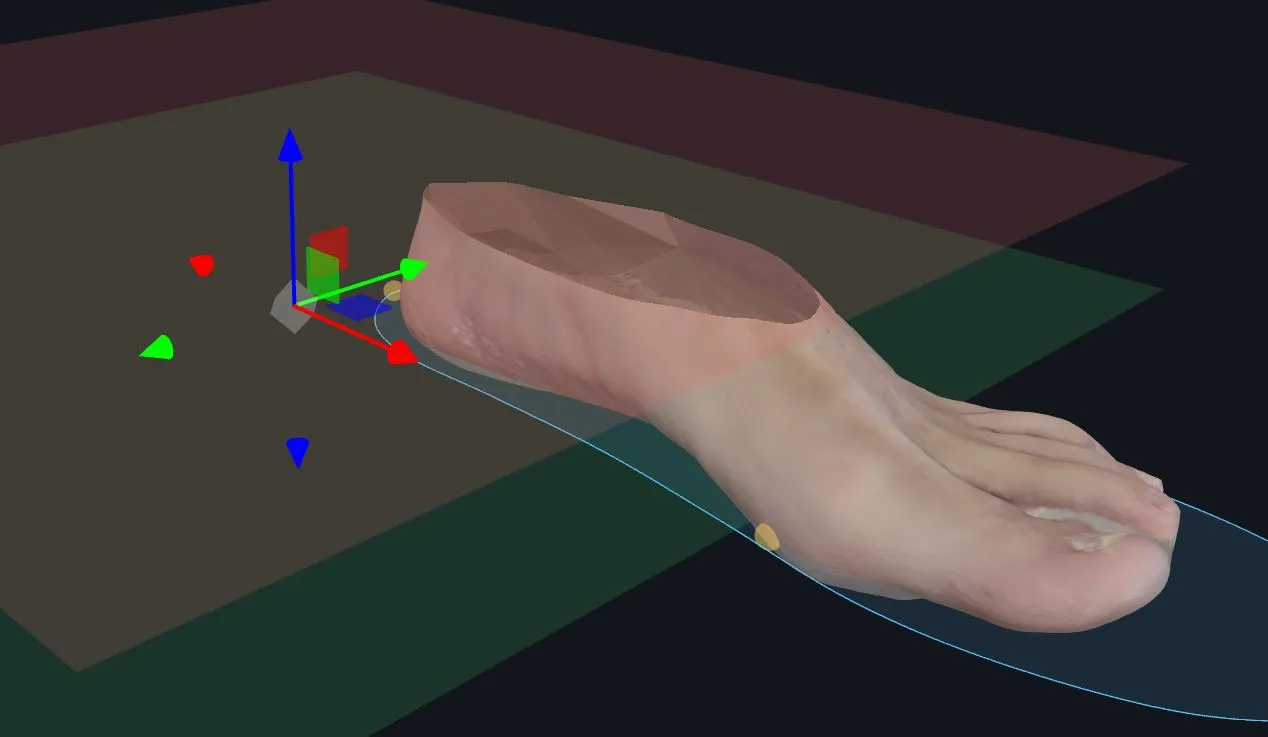
Import foot scans created with 3D scanners, mobile apps or external workflows and use them as visual reference to place the insole.
Compatible ecosystem
Podia3D exports STL and 3MF projects for reviewing, slicing and printing in TPU with common slicers and manufacturing ecosystems, without locking the insole into one vendor.
 Bambu Studio
 Ultimaker Cura
 OrcaSlicer
 PrusaSlicer
 Bambu Lab
 Prusa Research
 Creality
 Raise3D
 Ultimaker
Logos and trademarks belong to their respective owners. Compatibility is based on standard formats and should always be verified in the slicer before manufacturing.
Documentation that writes itself
Alongside the STL it generates the custom-made device declaration (Annex XIII, EU Regulation 2017/745), ready to archive.
Issued as a working draft: review, signature and final conformity are the manufacturer's responsibility. Prototype not certified as a medical device.
Unique device identification (UDI) by date, size and side.
Full prescription and recommended manufacturing parameters.
Mesh verification and the STL SHA-256 hash for design ↔ part traceability.
Manufacturer and prescriber details remembered between sessions; minimized patient code.
No vendor lock-in
Podia3D starts from verifiable parametric geometry and generates standard STL/3MF files you can review before manufacturing.
Scan as visual reference: it does not deform the insole or inject scan noise into the final mesh.
Watertight mesh validated before export, with geometry designed for FDM manufacturing in TPU.
Open STL for any slicer and 3MF with settings/modifiers prepared for Bambu Studio and OrcaSlicer.
MDR draft with prescription, manufacturing parameters and the STL SHA-256 hash for traceability.
The savings
Closed 3D-printing systems sell you software, machine and material as one locked bundle at an outrageous price. With Podia3D the software is independent: pair it with any FDM printer and off-the-shelf TPU.
Up to 50–70 % less than a closed printing system.
Market estimates; real savings depend on your volume and equipment. The Podia3D subscription is separate. Always verify manufacturing in your slicer.
FAQ
No. It is a v0 prototype for pilots. Any use with real patients requires professional control, manufacturing validation and regulatory compliance by the responsible manufacturer.
It should not be necessary. The interface works with clinical parameters such as arch, heel cup, postings, offloads, outline and firmness by zones.
No. The scan is used as a visual reference to position and size the insole. The final geometry remains parametric and controllable.
It exports STL for any slicer and 3MF projects with TPU material, orientation and modifiers prepared for Bambu Studio / OrcaSlicer workflows.
The STL uses a standard format and can be reviewed in any compatible slicer. Final manufacturing must always be validated with the actual printer, material and settings.
Ideally a workflow with a 3D scanner or reference cases, a compatible slicer and the ability to print TPU on FDM. We can also start with sample cases.
We define it with each professional. The goal is to test the full workflow: design, export, slicer review, print and collect clinical and manufacturing feedback.
For pilots with real cases, data should be minimized or anonymized, and processing instructions under GDPR should be agreed before sharing files.
Now
Podia3D is a v0 prototype. We are looking for professionals who want to test the workflow, validate STL/3MF in their slicer and print real TPU parts.
First 50 pilot seats get a 30% lifetime discount, in exchange for your feedback on the workflow and real-world printing.
The prototype is not yet certified as medical device software. MDR documentation is generated as a working draft and must be reviewed by the responsible manufacturer.